
Fiberglass Pool Installation in Silver Spring, MD
Silver Spring is a different kind of Montgomery County lot than Bethesda or Potomac. It’s the county’s older, denser, close-in urban district — streetcar-suburb grids from the 1920s and ’30s, lots measured in a few thousand square feet rather than acres, and a historic core with its own preservation rules layered on top of the county’s. None of that rules out a fiberglass pool. It does mean the math that governs where one can go, and the paperwork that governs whether it can go there at all, is genuinely different from what a Potomac or Bethesda homeowner deals with. This page covers what actually applies here.
The lot-coverage math that actually matters
Most of Silver Spring’s older neighborhoods sit in the county’s R-60 or R-90 residential zones. R-60 requires a minimum 6,000-square-foot lot and caps total lot coverage — house, garage, driveway and other impervious structures combined — at 35%. R-90 requires 9,000 square feet minimum and caps coverage at 30%. Either way, on a lot that size, coverage adds up fast.
Here’s the part that surprises people: Montgomery County’s zoning code specifically excludes a swimming pool from that lot-coverage calculation. A patio, a deck, an uncovered porch and a pool are all carved out under the code’s coverage-measurement rules. So a pool doesn’t eat into the percentage that limits how much house, garage and driveway you’re allowed.
But the same pool is still treated as an accessory structure for setback purposes — a separate rule from lot coverage. In R-60, an accessory structure needs 5 feet of clearance from the side and rear property lines, has to sit behind the house’s rear building line, and generally needs to be at least 60 feet back from the front lot line. In R-90, the same accessory-structure logic applies against that zone’s own building lines, with a 20-foot accessory height cap that rarely matters for a pool but can matter for an attached pool house. So the pool doesn’t cost you coverage percentage, but it still needs real, measured clearance on a lot that in Silver Spring’s older grid might only be 60 to 75 feet wide to begin with. Knowing which rule applies to which question — coverage percentage versus physical setback — is the first thing worth getting straight before you sketch a layout, and it’s a genuinely different calculation than the acreage-driven Forest Conservation Law math that governs a Potomac lot a few miles up the road.
The county’s standard building-permit process still applies on top of this: a separate electrical permit alongside the building permit, and a stated target of up to 17 days to issue a complete, well-prepared application. That timeline assumes the zoning and coverage questions above are already settled — it isn’t a substitute for working them out first.
Under 15,000 square feet: the runoff rule to know about
Nearly every R-60 and R-90 lot in Silver Spring falls under 15,000 square feet, which puts the property inside the size band Montgomery County Code §8-29B was written for — a rule requiring that, before certain permits are issued on small recorded lots, the plans show how the increased water runoff from new impervious surface will be safely conveyed or controlled rather than simply directed onto the neighbor’s yard. The statute’s clearest trigger is a new house or an addition that adds meaningful lot coverage; whether a stand-alone pool permit independently pulls in the same drainage-plan requirement is worth confirming directly with the Department of Permitting Services for your specific lot, since the rule was written with that small-lot runoff problem in mind either way. Practically, it means a Silver Spring pool project on a compact lot should plan for a real conversation about where deck and pool runoff goes, not assume it’s a non-issue because the pool itself doesn’t count against your coverage cap.
Two historic designations, two different rules
Silver Spring’s Capitol View Park neighborhood — along Capitol View Avenue, Meredith Avenue, Lee Street and Menlo Avenue — was Montgomery County’s first officially designated historic district, dating to 1979. “Designated” is the operative word: because it’s a real Chapter 24A historic district and not just a name on a map, exterior work on a property inside it — including decks, fences and porches, which are explicit categories on the county’s Historic Area Work Permit application — needs HAWP review from the county’s Historic Preservation Commission before a building permit can move forward. A pool sited where it’s visible from the street, or paired with fencing or a deck, is squarely the kind of work that review covers.
Contrast that with Woodside, a few blocks away. Woodside is only a Locational Atlas listing — a lighter, interim protection against demolition or substantial alteration while the county evaluates whether it merits full historic-district designation, not the same enforceable review Capitol View Park properties go through. As of an April 2026 Historic Preservation Division hearing, county staff had actually recommended narrowing Woodside’s Atlas listing down to just a handful of specific individually named properties — a church, a cemetery, a parsonage, and three named houses — rather than treating the whole neighborhood as protected. Where that stands today is worth confirming directly with Montgomery Planning before you assume either way — but the underlying lesson holds regardless of how it resolves: “listed” and “designated” are not the same thing in Montgomery County’s preservation system, and which one applies to your specific address determines whether HAWP review is required at all.
If your address is in neither Capitol View Park nor the Woodside Atlas area — which describes most of Silver Spring — this step doesn’t apply to you at all, and your project runs through the zoning and stormwater questions above without an added preservation layer. The point isn’t that every Silver Spring pool needs historic review; it’s that the answer genuinely depends on which few blocks you’re in, and it’s worth a direct check rather than a guess based on how old the surrounding houses look.
Filling and draining the pool
For anyone filling or draining a pool in the county, one rule is worth knowing that has nothing to do with permits or setbacks: Montgomery County’s Department of Environmental Protection regulates how pool water leaves the property. Chlorinated water needs to sit at least 48 hours after treatment (or test below 0.1 mg/L chlorine) before it’s discharged, backwash water has to go to the sanitary sewer rather than a storm drain, and pH needs to stay in the 6-to-9 range. It’s a small thing next to zoning and historic review, but it’s an actual county requirement, and it’s the kind of detail that’s easy to miss when the rest of the project’s attention is on permits and construction.
Getting a shell into a Silver Spring backyard
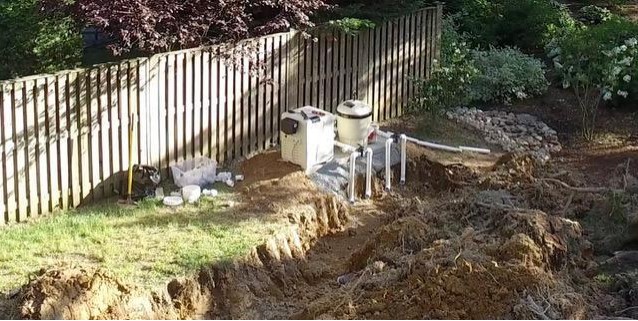
A one-piece fiberglass shell is rigid, typically 12 to 16 feet across, and it goes into the yard by crane or by careful trailer routing — there’s no version of the job where it’s carried in pieces through the house. Silver Spring’s older grid neighborhoods, with their narrower lots and closer-set houses, tend to make that access question more constrained than it would be on a larger Potomac or Bethesda parcel: side yards are often just wide enough for a person, mature street trees are common along these older blocks, and setting up a crane usually means occupying part of the street, which brings the county’s public right-of-way permit and a traffic plan into the schedule. It’s routine work, but it’s worth walking the actual access route before settling on a shell model, since the width you have to work with can rule some options out and leave others wide open.
Closer to Georgia Avenue and the older grid streets near downtown Silver Spring, on-street parking tends to be busier and more contested than in a Potomac cul-de-sac, so setting up a crane for the day is often more of a coordination exercise — worth building real lead time into the schedule rather than assuming it’s a quick setup.
On a shell-only project, where Calm Water Pools supplies the fiberglass pool shell and does not manage the full project, the coverage-versus-setback distinction above and this access question both land on your own plan set. The county reviews what’s submitted against the zone your lot sits in either way, whether we’re the ones pulling the permit or you are.
What the soil map shows for Silver Spring
The USDA Natural Resources Conservation Service (NRCS) soil map for Montgomery County shows Piedmont soils across most of Silver Spring, chiefly Glenelg and Gaila. NRCS describes both as very deep, well drained and formed in weathered schist, with bedrock more than 60 inches down.
Exceptions matter for a pool. On steep slopes the map shows Blocktown soil, which NRCS calls shallow: weathered rock 10 to 20 inches down and hard bedrock at 20 to 40 inches. In stream valleys, Hatboro is a poorly drained floodplain soil. Toward Takoma Park the map shows Coastal Plain soils such as Chillum and Croom.
The map units here include no marine-clay series. As practice, not code, rock on steep ground and water near the creeks are the likelier site questions. Latham’s installation overview describes a sump line or daylight drain at the deep end to balance hydrostatic pressure.
Backing onto parkland, a stream or a protection area
Montgomery Parks prohibits encroachment on park property, and its Park Rules and Regulations, effective July 1, 2025, list pools, decks, pits and grading as examples. That matters for lots backing onto Sligo Creek Stream Valley Park, which runs from Takoma Park to Wheaton Regional Park, or Northwest Branch Stream Valley Park, which covers more than 1,320 acres.
Floodplain is its own gate. The county’s floodplain district permit rules, including the 30-acre drainage test and the 25-foot buffer, are covered on our Potomac page.
In the far northeast, around Fairland Road, Briggs Chaney Road and Columbia Pike, the county’s map places the Upper Paint Branch Special Protection Area. Montgomery Planning says any land-disturbing activity there falls under SPA rules, without the exemptions other areas have. Check your address on the county’s SPA map. Countywide sediment-control and tree rules are on our Bethesda page.
If your address is inside Takoma Park
Takoma Park is an incorporated city with its own tree rules. The City’s Tree Protection Plan packet (updated April 2021) covers Urban Forest Trees, over 24 inches around, within 50 feet of a project’s impacts. It begins with a tree impact assessment and holds the permit through a 15-day neighbor comment period. Confirm first that your parcel is inside city limits.
If the old pool is inside Takoma Park: the municipality letter comes first
The City of Takoma Park’s municipality letter page says any renovation, building or outdoor project that needs a Montgomery County Department of Permitting Services permit first requires a Municipality Letter from the City. There is no fee, and the letter is not a permit. Its job is to tell you about additional City permits for tree protection, stormwater management and anything in the City right-of-way, such as driveway aprons, dumpsters and fences. A dumpster at the curb for old-pool debris is the kind of item that last category can catch.
The page mentions neither pools nor demolition, and the county has not published a rule for removing a pool, so ask the City’s planning staff (planning@takomaparkmd.gov) and the county permitting department (240-777-0311) which permits your removal needs, and in what order. Outside city limits, the county rules alone apply. The tree rules above matter here too, because the work area for removing a pool can reach a protected tree’s root zone. See partial vs full pool removal for what to ask about the structure itself.
A sensible order of operations
- Confirm your zone — R-60 or R-90 — and work out both numbers separately: your lot-coverage percentage and your accessory-structure setback. They’re not the same question.
- If your lot is under 15,000 square feet, which most are here, ask Permitting Services directly whether §8-29B’s runoff-control plan applies to a stand-alone pool permit on your property.
- Confirm whether your address sits inside Capitol View Park, inside the Woodside Locational Atlas area, or in neither — and get the county’s current read on what that means for HAWP review before you finalize a layout.
- Walk the access route to the back yard and decide early whether this is a side-yard job or a crane job.
- If it’s a crane job, plan for the public right-of-way permit and a traffic plan as part of your schedule, not an afterthought.
- Then choose a shell that fits the setbacks and access you’ve actually confirmed.
What Calm Water Pools does in Silver Spring
We are a family-owned fiberglass pool company based in Clarksburg, in Montgomery County, since 2008, working across Maryland, Washington DC, Northern Virginia and nearby West Virginia. Silver Spring is the same county we’ve built in for years — different zoning numbers than Bethesda or Potomac, but the same permitting office and the same inspectors.
In Silver Spring we offer full fiberglass pool installation, managing the project from shell selection through a finished pool and coordinating the build with licensed independent contractors; pool removal and replacement for aging concrete, vinyl-liner or damaged fiberglass pools; and fiberglass pool shells supplied on their own to homeowners, builders and contractors running their own installations. We also supply inground winter safety covers.
If you’re working out whether a Silver Spring lot — inside the historic district or not — can take a pool within its actual setbacks, that’s worth a conversation before you’ve picked anything out. Call 240-372-4440 or request a free quote.
Permit requirements, zoning figures and historic-district status change, and Woodside’s designation status in particular is under active county review as of this writing. Everything above reflects our understanding of Montgomery County requirements at the time of writing and is general guidance, not a substitute for confirming the current rules for your specific property with Montgomery County Department of Permitting Services and Montgomery Planning.
Related Reading
- Fiberglass pool FAQ — permits, timeline, installation quality and care
- Fiberglass pool installation in Bethesda, MD
- Fiberglass pool installation in Potomac, MD
- Choosing a fiberglass pool: the complete guide
- Fiberglass pool installation in Kensington, MD
- Fiberglass pool installation in Washington, DC