
Fiberglass Pool Installation in Prince William County, VA
Prince William County is the most physically varied of the Northern Virginia counties — the Potomac shoreline and the dense older subdivisions around Woodbridge and Dale City at one end, Manassas, Bristow and Gainesville through the middle, and the county’s rural western area out past Nokesville and Haymarket. What ties a pool project together across all of that is not zoning. It is ground conditions. Prince William is the one county in the region that formally rates its own soil, and by its own reckoning roughly 40% of it is not straightforwardly suitable for supporting structures without engineering. That single fact shapes more fiberglass pool projects here than anything in the zoning ordinance.
Who approves what, and in what order
Prince William runs pool approvals in a specific sequence, and going out of order costs weeks.
- Zoning Division first. You submit copies of a house location survey plat drawn to scale with the proposed pool, dimensions and setbacks to the property lines shown. Zoning confirms the pool can sit where you have drawn it.
- Prince William Health District if the property has a private well or septic system. Written approval is required — this is not optional or informal.
- Department of Public Works, Watershed Branch if any part of the pool falls inside a Resource Protection Area. Written authorization is required before the permit proceeds.
- Building Development Division for the permit itself, plan review and inspections.
On permits, expect the building permit plus a separate electrical permit for lighting, circulation equipment and receptacle outlets, a gas permit for a fuel-fired heater, and — a detail specific enough that it catches people — a plumbing permit if the pool has a permanent fill line or any connection to sanitary sewer. Building Development is at 5 County Complex Court.
The three-acre line in the zoning ordinance
Prince William’s accessory-structure rules turn on whether your lot is over or under three acres, which is a cleaner rule than most jurisdictions use and worth knowing before you sketch anything.
On lots of three acres or less, the pool and its equipment may be located in the rear or side yard only — not the front. If the pool sits at the rear, it and the equipment must be at least five feet from the rear and side property lines. If it sits in a side yard, it has to hold the same setbacks as the primary structure for that zoning district, which are considerably deeper. Any detached structure, including the pool and its deck, must also be at least five feet from the dwelling. On a corner lot, a minimum 20-foot setback applies from the side property line adjacent to the side street.
On lots greater than three acres in the A-1, SR-5, SR-3, SR-1, R-2, R-4, RPC, PMD and PMR districts, in-ground pools are instead subject to the required yards, setbacks and lot coverage of the district they sit in.
The practical consequence: on a standard quarter-acre lot in Dale City or Linton Hall, the five-foot rear and side line is generous and the binding constraint is usually the equipment pad and the deck, not the pool. Push the pool toward a side yard to gain access room and you suddenly inherit the house’s setbacks instead — which is often what kills that idea.
Category II and Category III soils
This is the Prince William-specific one, and it is unusually well documented because the county did the work itself.
The 1989 USDA soil survey of Prince William County describes 56 soil types, which with slope classes and erosion become 91 mapped soil units. For building code and Design and Construction Standards Manual purposes the county sorted all 91 into three categories:
- Category I — good soils. Everything not in II or III. Fine for supporting foundations.
- Category II — potential problem soils. High groundwater, non-durable rock, shallow rock, and natural asbestos formations.
- Category III — problem soils. High shrink/swell soils, marine clay, compressible soils, existing uncontrolled or undocumented fill, and floodplain or perennial high groundwater. The county’s own note on this category is blunt: significant engineering difficulties anticipated.
By the county’s estimate, Category II and III soils cover approximately 40% of Prince William County. On those, a geotechnical report is a normal part of the process rather than an exotic add-on, and where problem soils are confirmed, earthwork and foundation inspection falls under a geotechnical engineer of record.
What each of those means for a one-piece fiberglass shell specifically:
- Marine clay and high shrink/swell — mostly a concern in eastern Prince William, where the Marumsco soils take their name from Marumsco Creek. These clays expand when wet and contract when dry. They make excavation sidewalls less stable, they drain badly, and they are the wrong material to put back around a shell, because a swelling clay loads a rigid one-piece structure unevenly. Clean, free-draining backfill is the baseline here, not an upgrade.
- Shallow and non-durable rock — more common in the western half, where diabase and other hard intrusive rock sits close to the surface. Rock does not stop a pool, but it changes the excavation from a day’s digging to a different scope of work entirely, and it needs to be identified before a price and a schedule mean anything.
- High groundwater — see below. It is the one that matters most for fiberglass and the one homeowners understand least.
Groundwater, and why it matters more for a fiberglass pool
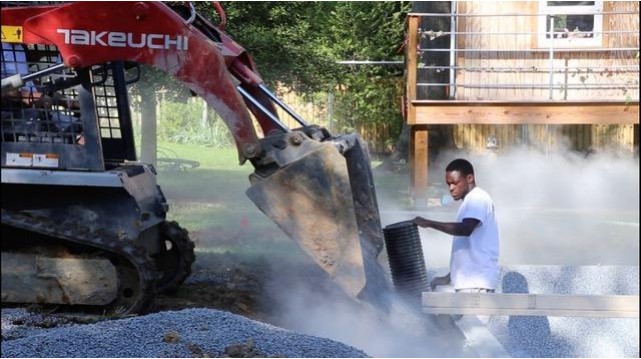
A fiberglass shell is a large, sealed, relatively light structure. Water in the ground around it exerts uplift. When a pool is full, its own weight holds it down comfortably; the risk arises when the water table rises while the pool is empty or partially drained — after a wet spring, during a liner-era pool’s replacement, or at winterizing time if someone lowers the water too far.
Handled properly this is a solved problem, and the solutions are standard: a properly bedded and drained gravel base, a hydrostatic relief valve in the floor, a dewatering system or sump where the water table warrants it, and — perhaps most importantly — never draining the pool without understanding what the groundwater is doing. On a Category II high-groundwater site in Prince William, those are not optional refinements. They are the reason the installation lasts.
This is also a good example of why the soil category is worth knowing before you sign anything. It changes what a correct installation looks like on your specific lot, and it is a fair question to ask any contractor you are considering.
Land disturbance: 2,500 square feet, including the way in
As a Chesapeake Bay Act locality, Prince William requires a Land Disturbance Permit once disturbance exceeds 2,500 square feet. The county is explicit that this includes incidental disturbance such as access ways — the route your equipment takes across the lawn counts toward the total along with the excavation, the spoil, the staging and the deck.
That matters more here than in a denser county, because Prince William lots are frequently deep. A pool 120 feet from the street can accumulate a great deal of disturbed area simply getting equipment to the back of the property. It is worth measuring rather than assuming.
Resource Protection Areas and the Occoquan Reservoir
Prince William designates Resource Protection Areas under the Chesapeake Bay Preservation Act — generally the land within 100 feet of perennial streams, tidal shores and wetlands. If the pool falls inside one, the Watershed Branch has to authorize it in writing before the permit moves.
There is also a broader watershed context here that does not exist elsewhere in the region. The Occoquan Reservoir is a drinking water source for a very large share of Northern Virginia, and the land draining into it is among the most environmentally sensitive in the county — a concentration of steep slopes, erodible soils, streams and RPAs, and the highest tree cover per acre anywhere in Prince William. The county’s 2022 Comprehensive Plan formalized an Occoquan Reservoir Protection Area reflecting that, with the intent of limiting impervious surface and land disturbance in the watershed.
If your property sits in the Occoquan drainage — much of the Lake Ridge, Occoquan, Woodbridge and Bull Run area does — expect environmental review to be a real part of the process rather than a formality, and check the county’s mapping before you settle on a pool location.
Wells and septic in the rural west
West of the development boundary, in the rural area still widely called the Rural Crescent, most properties run on private wells and septic systems. Prince William requires written Health District approval for any lot with a well or septic system before a pool permit proceeds — a firmer requirement than a number of neighboring jurisdictions apply.
Practically, that means locating the drainfield and its reserve area on a plan, not from memory. You cannot build over either, and the reserve — the ground set aside for a future replacement field — is protected precisely because it has to stay undisturbed and uncompacted. On rural lots it is very often the flattest and most attractive part of the yard. Two other things to settle early: where filter backwash and any pool draining will go, since it does not go into the septic system, and whether the well can fill a pool at a reasonable rate without being run down.
Getting the shell into the backyard
A one-piece fiberglass shell is typically 12 to 16 feet wide and completely rigid, and Prince William offers two distinct versions of the access problem.
In the older eastern subdivisions — Dale City, Woodbridge, parts of Lake Ridge — houses sit close together on modest lots with fully fenced rear yards, and the side-yard gap is often too narrow. Craning over the house is a routine answer where there is overhead clearance to do it.
In the west, space is abundant but the route can be the problem: long gravel or dirt lanes, soft shoulders after rain, farm gates narrower than a delivery trailer, mature tree lines with low branches, and grades a loaded truck should not attempt. Add shallow rock in some of that terrain and the excavation itself can need equipment that has to get to the same place.
Either way, the access route is the first thing worth walking with a tape measure. It constrains everything that comes after it.
HOAs in the planned communities
Much of Prince William’s growth came as master-planned communities, and most of them carry architectural review — Lake Ridge, Montclair, Braemar, Dominion Valley, Piedmont and many more. That review is separate from the county’s process and frequently slower.
Associations here commonly govern fence style, height and color, equipment placement and screening, decking material, construction hours and where trucks may stage. Some require their approval before you apply to the county. An association cannot override the building code, but it can comfortably add a month to a project that is otherwise ready, so submit to both in parallel. Our guide to how HOAs affect your fiberglass pool project goes through what to expect.
Barrier requirements
Virginia’s building code adopts the International Swimming Pool and Spa Code, so the barrier standard is consistent statewide: at least 48 inches high measured from the ground on the outside, no opening that will pass a 4-inch sphere, and gates that are self-closing, self-latching and swing away from the pool. The fence normally needs its own permit, and a final barrier inspection is required before the pool goes into use. Your HOA’s fence standard will often be more prescriptive than the code’s.
Check which government reaches your parcel first
Prince William County’s Development Services does not serve the Town of Dumfries or the Cities of Manassas and Manassas Park. In the Towns of Occoquan, Haymarket and Quantico, the town issues zoning approval and the county issues the building permit. A mailing address with one of those names does not settle it. Use the county’s jurisdiction look-up.
The county’s only historic overlay district is Buckland, 19 acres on both sides of Route 29 near the Fauquier County line. If your parcel is inside it, Section 32-502.05 of the zoning ordinance requires a Certificate of Appropriateness before any structure is erected or any excavation is made. The Architectural Review Board has 60 days from a complete submission to act.
Stream-buffer and floodplain rules reach pools
The county’s Resource Protection Area (RPA) page names pools among the accessory structures owners cannot place inside the 100-foot stream buffer. Section 32-504.06 of the zoning ordinance applies that bar to lots recorded after November 27, 1990, unless an exception is granted. The county’s Design and Construction Standards Manual allows an administrative exception for older lots but excludes accessory structures that would further reduce the buffer width. Other requests go to the Chesapeake Bay Preservation Area Review Board at a public hearing.
- Section 32-504.05 designates all land outside an RPA as a Resource Management Area.
- Manual Section 750.03 requires Public Works approval for any disturbance in an RPA or floodplain, including vegetation removal, regardless of size.
- Manual Section 741.01 says no construction access should run through an RPA without the Public Works director’s specific approval.
In the Flood Hazard Overlay District, Section 32-501.09 allows lawns, gardens and play areas in the floodway fringe only where no structure or fill is needed. Other uses are prohibited unless the Floodplain Administrator, the Director of Public Works, waives development standards. The ordinance’s definition of “structure” names swimming pools. If the County Mapper shows floodplain on your lot, ask Public Works how this applies.
Zoning approval has to cover more than the shell
The county’s zoning-approval guide says a deck, patio, sitting wall or retaining wall belongs in the same application or needs its own approval. It says:
- Environmental Management reviews the project before zoning issues if the lot has an RPA, a 100-year or FEMA floodway area, a storm drain easement or a conservation or buffer area.
- Easement holders may need to approve in writing.
- Retaining walls over three feet high, measured under the building code, need zoning approval (Section 32-300.03).
The same section treats an accessory structure joined to the house by a walkway, steps or other impervious surface as detached, subject to all required yards. Ask how the office applies that to a patio running from house to pool. If your lot’s rezoning carried proffers, Section 32-700.30 bars approval of any permit application that does not conform to them.
Where pool water may go is regulated
County Code Section 23.2-4.1 makes it unlawful to discharge chlorinated pool water into the stormwater system without dissipating the chlorine. A knowing violation is a Class 1 misdemeanor. Otherwise the civil penalty is $250 to $1,000 for each day (Section 23.2-4.4). The county’s pool-draining notice asks owners to stop adding sanitizer at least ten days before draining and to confirm chlorine reads zero.
The sanitary sewer is not an automatic alternative. Section 23-53 lists swimming pool drainage among discharges the utility’s superintendent must specifically authorize. Section 23-21 says pool waste is examined case by case. A removal-and-replacement project empties a whole pool, so settle where the water goes first.
Taking out an old pool in Prince William County
The county’s Building Development Division has written that the Virginia Uniform Statewide Building Code requires a permit before a building or structure is demolished, and that the code’s definition of a structure lists swimming pools (Building Official Interpretation 2018-12, dated September 29, 2021). That interpretation is about piers and boat docks and cites the 2018 code edition, so treat it as a strong signal that removing a pool needs a permit, and confirm the current rule with the division at 703-792-6930.
We found no county page that sets one method for emptying and filling a pool. What comes out, how the floor is handled and what the fill must meet are questions for the building office, and the answers should be in writing. The water comes first, and the draining rules above apply before any of that work starts. Our guides to partial vs full pool removal and backfill and compaction list what to ask.
A sensible order of operations
- Find out which soil category your lot falls in. With 40% of the county in Category II or III, this is the question most likely to change the scope of the work.
- Check for an RPA and whether you are in the Occoquan watershed.
- Locate your septic field and reserve area if you are not on public sewer, and plan for Health District approval.
- Pull your house location survey plat. Zoning wants it, and it shows setbacks and easements.
- Apply the three-acre test and confirm which setback rules govern your lot.
- Measure the access route and total disturbed area, including the way in, against 2,500 square feet.
- Then pick a shell that fits the envelope you have actually confirmed.
What Calm Water Pools does in Prince William County
We have been a family-owned fiberglass pool company since 2008, working across Maryland, Washington DC, Northern Virginia and nearby West Virginia. In Prince William County we offer full fiberglass pool installation, managing the project from shell selection through a finished pool and coordinating the build with licensed independent contractors; pool removal and replacement for aging concrete, vinyl-liner or damaged fiberglass pools; and fiberglass pool shells supplied on their own to homeowners, builders and contractors running their own installations. We also supply inground winter safety covers.
On a county where ground conditions vary this much street to street, the useful conversation is the one that happens before a design exists. Call 240-372-4440 or request a free quote.
Ordinances, soil mapping and permit thresholds change. Everything above reflects our understanding of Prince William County requirements at the time of writing and is general guidance, not a substitute for confirming the current rules for your specific property with Prince William County Building Development Division.