
Fiberglass Pool Installation in Loudoun County, VA
Loudoun County is really two building environments wearing one name. East of Route 15 you have the suburban corridor — Ashburn, Sterling, Brambleton, Broadlands, South Riding — where lots are smaller, everything is on public water and sewer, and a homeowners association usually has more to say about your project than the county does. West of Leesburg you have farmland, wooded slopes, wells and septic systems, and two zoning overlays that can genuinely change where a pool is allowed to go. A page of generic Northern Virginia pool advice will steer you wrong in both halves. This one is about what Loudoun specifically asks of a fiberglass pool project.
Who issues the permit
Residential pool permits go through the Loudoun County Department of Building and Development at the county government center in Leesburg. You will normally submit a permit application together with a plat of your property showing where the pool is going.
Expect the pool building permit itself plus a separate electrical permit for lighting, bonding, receptacles and circulation equipment, and a gas permit if you are installing a fuel-fired heater. Under the Virginia Uniform Statewide Building Code a permit is triggered by water deeper than 24 inches, which every inground fiberglass pool clears comfortably. Inspections are required at set stages, and the approved plans have to be on site or the inspector will not perform the inspection. Loudoun’s pool permit page is the authoritative starting point.
The 5,000 square foot grading trigger
Loudoun requires a grading permit for erosion and sediment control once you disturb more than 5,000 square feet of land. That number is worth committing to memory, because it is not the same as the county next door — Fairfax County works to a 2,500 square foot threshold, and homeowners who have read Fairfax guidance routinely assume the tighter number applies here.
Disturbed area is measured as everything you touch, not just the pool footprint: the excavation, the spoil pile, the equipment route across the lawn, staging, and the deck and hardscape that go in around the pool. On a typical eastern Loudoun lot with a modest patio, a pool project can stay under 5,000 square feet. Add a wide wraparound deck, a long access route across the yard, or a retaining wall, and it does not. Crossing the line is not fatal — it means engineered drawings and a separate review that adds time before the building permit is issued. It just needs to be planned for rather than discovered.
The Limestone Overlay District, and why pools get named in it
This is the Loudoun-specific rule that catches people out, and it is unusual enough that most homeowners have never heard of it.
North of Leesburg and west toward the Catoctin Creek, a band of the county sits on karst — carbonate bedrock that dissolves over time, producing sinkholes, underground solution channels, springs and streams that vanish into the ground. Loudoun mapped that band in 2010 as the Limestone Overlay District and wrote a chapter of the zoning ordinance around it, aimed at subsidence risk and groundwater contamination.
Inside the district, most small projects get a break: land disturbance of 600 square feet or less is exempt from the district’s setbacks and development standards. Swimming pools are explicitly excluded from that exemption. The ordinance names them — along with dwellings and anything built to change water flow — as activities that do not qualify no matter how small they are. In practice that means a pool anywhere in the Limestone Overlay District requires a Geophysical Study under Chapter 6 of the county’s Facilities Standards Manual, identifying sinkholes, swallets and closed depressions, rock outcrops, cave openings, springs, perennial sinking streams, and underground solution channels within 45 feet of the surface. If that study recommends it, a Geotechnical Report follows to confirm what is actually down there.
Anything the study finds carries a setback. The ordinance’s table is specific:
- 100 feet from a sinkhole, swallet or closed depression
- 100 feet from a cave opening
- 100 feet from the first emergence of a spring — 200 feet if that spring is on a slope steeper than 15% and sits downhill of your work
- 100 feet from a perennial sinking stream
- 50 feet from underground solution channels within 45 feet of the surface
- 50 feet from any other identified karst feature
Those setbacks can be reduced by up to half if the Geophysical Study concludes the collapse and contamination risk is insignificant — but no reduction is allowed for springs, perennial sinking streams, or any sinkhole or cave opening that takes in a stream. On a two-acre lot, a single mapped sinkhole with a 100-foot buffer can eliminate the obvious pool location entirely.
If your property is west or north of Leesburg, check the overlay before anything else. The county publishes the district boundary as a mapped GIS layer, and Building and Development administers it. Finding out you are in it after you have chosen a shell model is an expensive order of operations. The full text is Section 5.05 of the Loudoun County Zoning Ordinance.
Mountainside land — Catoctin and the Blue Ridge
The other western overlay is the Mountainside Overlay District, covering the slopes of Catoctin Mountain and the Blue Ridge. It sorts land into somewhat sensitive, sensitive and highly sensitive areas and then limits how much tree cover you may clear and how much ground you may disturb, tier by tier.
The practical shape of it: on forested land, selective clearing is capped at a percentage of existing tree cover and only to the extent needed to locate the use. On unforested slopes between 15% and 25%, permitted land disturbance is cut back sharply — by half in somewhat sensitive areas and more in the more sensitive tiers — and only if you can show there is no suitable alternative on gentler ground. There are also hard protections: covered activities are not permitted within a mapped ridge feature at all, and must stay at least 300 feet back from a spring feature.
If you own mountainside acreage, the flat, cleared, obvious spot for a pool is frequently the one part of the lot the overlay is designed to keep you out of. That is worth establishing before design starts, not after.
One thing Loudoun does not have
Homeowners moving from Fairfax, Arlington or Prince William often arrive expecting to deal with Resource Protection Areas — the 100-foot stream buffers created under Virginia’s Chesapeake Bay Preservation Act. Loudoun is not a Bay Act locality. The Act applies to the jurisdictions the state defines as Tidewater Virginia, and Loudoun, like Fauquier, sits outside that list.
That does not mean water features are unregulated here — the county’s Floodplain Overlay District, the Limestone Overlay District’s karst setbacks, and standard erosion and sediment control all apply, and the Facilities Standards Manual sets stream and drainage requirements. But the specific RPA process that dominates pool siting one county east simply is not the framework in Loudoun. Advice written for Fairfax does not transfer cleanly, in either direction.
Wells and septic in the rural west
Once you are outside the public water and sewer envelope, the septic system becomes the single biggest constraint on where a pool can physically go — more often than property lines do.
You cannot build over a drainfield, and you cannot build over the reserve area either: the undeveloped ground set aside for a future replacement field. That reserve is protected precisely because it has to stay available, and it is frequently the flattest, sunniest, most inviting part of a rural lot. Excavation, heavy equipment traffic and the compaction that comes with it are all problems over a field or its reserve, quite apart from the setback rules. Separation distances from wells and from the drainfield are set in the Virginia Department of Health’s regulations and are confirmed through the Health Department, not through Building and Development.
Two related items worth settling early on well-and-septic properties: where filter backwash and any pool draining will discharge — it does not go to the septic system — and whether your well can fill a pool at a sensible rate without running the system dry, which for many rural Loudoun wells means arranging a water delivery instead.
HOAs in eastern Loudoun
Eastern Loudoun is one of the most comprehensively HOA-governed places in Virginia. Ashburn, Brambleton, Broadlands, Lansdowne, South Riding, Stone Ridge, One Loudoun — the master-planned communities that built out the corridor from the 1990s onward almost all came with architectural review, and many of them administer it strictly.
Architectural approval is entirely separate from your county permit, and it is often the slower track. Associations commonly govern fence style, height and color, where pool equipment sits and how it is screened, decking material and finish, permitted construction hours, and where trucks and equipment may stage on a street with narrow frontages and limited parking. Some require their sign-off before you go to the county. Committees that meet monthly, and can defer a submission to the next meeting for a missing detail, quietly become the critical path.
An association cannot override the building code, but it can comfortably add a month to an otherwise ready project. Submit to both in parallel and read the covenants before you commit to a design. We cover the process in our guide to how HOAs affect your fiberglass pool project.
Getting the shell into the backyard
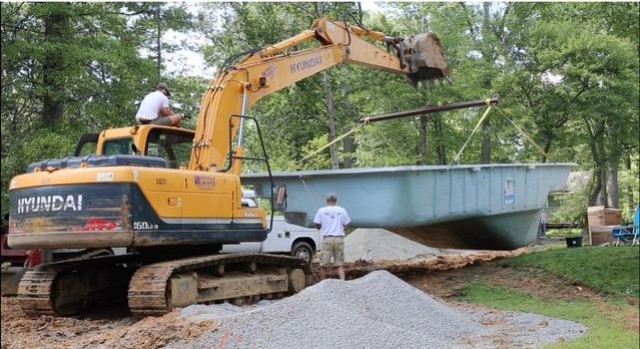
A one-piece fiberglass shell is typically 12 to 16 feet wide and completely rigid. Loudoun presents two different access problems depending on which half of the county you are in.
In the eastern subdivisions, the constraint is width. Houses on 6,000 to 10,000 square foot lots sit close to their neighbors, side yards are often too narrow for the shell and the equipment to pass, and rear-loaded garages and alleys can help or hinder depending on turning room. Craning over the house is a routine solution, but it needs clear overhead space — and newer communities are dense with utility easements and street trees.
West of Leesburg the constraint is different: long gravel driveways with soft shoulders, mature tree lines, low overhead branches, farm gates too narrow for a delivery trailer, and grades that a loaded truck cannot safely climb. Space is rarely the issue; getting a wide, heavy load to the space is. Either way, the access route is the first thing that should be walked and measured, because it constrains every decision after it.
Fencing and barriers
Virginia’s building code adopts the International Swimming Pool and Spa Code, so the barrier rules are the same statewide: a minimum 48-inch barrier measured from the outside ground level, no opening large enough to pass a 4-inch sphere, and gates that are self-closing, self-latching and swing away from the pool. The fence itself normally needs its own permit. In eastern Loudoun the practical constraint is usually not the code minimum but the HOA standard sitting on top of it, which may dictate a specific style, color and height.
The zoning permit comes first, and it expires
In unincorporated Loudoun, Section 10.04 of the county’s Zoning Ordinance requires a Zoning Permit before a building permit is issued and, with a narrow exception for conditional grading permits, before excavation or grading begins. Each structure on the property needs its own. A permit lapses if work has not started within one year of issue, or stops for a continuous year. The Zoning Administrator may extend it up to one more year on a written request made at least 30 days before expiry.
What to check: the permit’s issue date against your build schedule.
Near a stream, a steep slope or an overlay, size stops mattering
The 5,000 square foot grading trigger above has exceptions. In a river and stream corridor buffer and on steep slopes of 15 percent or more, Table 6.04-1 of Chapter 6 requires a grading permit for all land disturbing activity, notwithstanding the exceptions in Codified Ordinances Chapter 1220, plus a locational clearance from Building and Development. The Limestone Overlay (Section 5.05.F) and Mountainside Overlay (Table 5.04-4) also require a grading permit.
The table applies to activities “on any parcel” that includes a buffer or steep slope area. Section 6.02 disregards a steep area under 5,000 square feet in Rural, Transition and Joint Land Management districts, under 10,000 in Urban and Suburban districts, or narrower than 15 feet.
What to check: whether the county’s map shows any of these on your parcel, and how the office reads the table for a pool on level ground.
Your zoning district decides whether you are on a well
Section 7.08 of the ordinance sets water and sewer by district. Development in Urban, Suburban and Transition districts must be served by central water and sewer, though a Transition lot that existed before December 13, 2023 and needs no subdivision or site plan may keep individual systems unless Codified Ordinances § 1066.09 requires a sewer connection. Rural districts must use individual systems, with listed exceptions, among them a county service district and a health risk identified by the Health Department.
Loudoun Water operates community systems in some rural villages. It says their capacities are limited and may not be designed to provide all of the Central System’s amenities, such as lawn watering. The page does not mention pools.
What to check: your district and system (Loudoun Water’s service area map accepts an address), and whether that system can supply a fill.
Loudoun’s soils change with the geology
The county’s soil guide, updated in 1998, places the eastern half of Loudoun in the Piedmont and the western half in the Blue Ridge, with the footslopes of Catoctin Ridge as the boundary. It sorts the county into 22 general soil associations. The largest, Purcellville-Tankerville-Middleburg, covers 21 percent.
The Virginia Department of Energy’s geologic descriptions map a Mesozoic basin, the Culpeper basin, of sandstone, siltstone and shale with basalt flows and diabase. For soils weathered from diabase and basalt (Haymarket-Elbert-Waxpool, 6 percent) the guide cites high shrink-swell clays and seasonal water tables. Sycoline-Kelly-Catlett (5 percent) cites high shrink-swell clays and seasonal wetness.
As practice, not code: Latham’s installation overview names rock and water issues as unforeseen ground conditions. The guide says its map is not for specific sites, so check your parcel in Web Soil Survey and ask for a site-specific investigation.
Emptying an old pool in Loudoun County: sewer coordination
Where a Loudoun pool is drained to the sanitary sewer, Loudoun Water’s guidelines for swimming pool discharges ask owners to neutralize chlorine concentrations, estimate the volume of water, and coordinate the discharge with its Pretreatment Division (571-291-7889). Loudoun County Code 838.37.1.c adds that when only a sanitary sewer is available to a pool, the rate of discharge is subject to the approval of the appropriate sewer authority. A removal or replacement schedule should leave room for that conversation before the pump goes on. On the septic-served lots in the western county, none of this water goes to the septic system, as noted above.
We found no Loudoun County page that says which permit removing a pool needs, so ask the county’s building permit office before the work is priced or scheduled. Our guides to partial vs full pool removal and how to verify a pool removal contractor cover the questions to bring, and our pool removal and replacement page explains how Calm Water Pools coordinates removal and replacement.
A sensible order of operations
- Find out whether you are in the Limestone Overlay District or the Mountainside Overlay District. Either one can rule out a location outright.
- Locate your septic field and reserve area if you are not on public sewer, before you pick a spot.
- Pull your plat. You need it for the permit, and it shows setbacks and easements.
- Read your HOA’s architectural guidelines and find out when the committee meets.
- Walk the access route with a tape measure, from the road to the pool location.
- Add up your disturbed area including deck and staging, and see where you land against 5,000 square feet.
- Then choose a shell that fits the envelope you have actually confirmed.
Every step above is free. Doing them in reverse order is how projects stall for a season.
What Calm Water Pools does in Loudoun County
We have been a family-owned fiberglass pool company since 2008, working across Maryland, Washington DC, Northern Virginia and nearby West Virginia. In Loudoun County we offer full fiberglass pool installation, managing the project from shell selection through a finished pool and coordinating the build with licensed independent contractors; pool removal and replacement for aging concrete, vinyl-liner or damaged fiberglass pools; and fiberglass pool shells supplied on their own to homeowners, builders and contractors running their own installations. We also supply inground winter safety covers.
If the question on your mind is whether your Loudoun County lot can take a pool at all — overlay district, septic field, access route and all — that is worth working out before you have picked anything out. Call 240-372-4440 or request a free quote.
Ordinances, overlay boundaries and review thresholds change. Everything above reflects our understanding of Loudoun County requirements at the time of writing and is general guidance, not a substitute for confirming the current rules for your specific property with Loudoun County Building and Development.