Fiberglass Pool Installation in Jefferson County, WV
Jefferson County is a different market than the Maryland suburbs and D.C. rowhouses we also serve — this is West Virginia’s Eastern Panhandle, roughly 45 minutes from Shepherdstown, where lots run from planned subdivisions near Charles Town and Ranson out to genuinely rural acreage with a well and a septic system instead of county water and sewer. It’s also sitting on some of the most geologically distinctive ground in the state, which matters more for a pool excavation than almost anything else on this page. Here’s what actually governs a fiberglass pool project here.
The ground here is different: karst
Start with geology, because it’s the one fact that changes how a pool project here is planned compared to almost anywhere else we build. Jefferson County is underlain by Conococheague and Stonehenge limestone, and by the account of the West Virginia Encyclopedia, no county in the state has a greater percentage of karst terrain. Karst means bedrock that dissolves over time — sinkholes, underground voids, caves, and a depth to solid rock that can vary sharply from one side of a yard to the other, in ways that don’t show up just by looking at the surface.
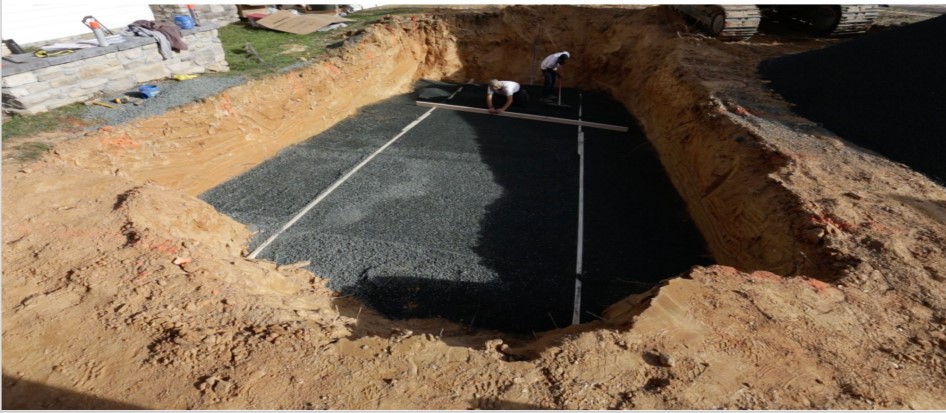
For most construction that’s a background fact. For an inground pool, it’s directly relevant. A one-piece fiberglass shell needs a stable, uniformly prepared base — a void or an unexpected shelf of rock a few feet down changes the excavation plan, the bedding material, and sometimes the pool’s location entirely. It’s also the reason a geotechnical or soil assessment before you commit to a spot in the yard is worth treating as a real step in the process here, not a formality, in a way it typically isn’t in the Maryland suburbs a few miles east.
Zoning applies here — unless you’re inside a town
West Virginia counties often have little or no zoning at all. Jefferson County is an exception: it has had a comprehensive Zoning and Land Development Ordinance since 1988, most recently amended in June 2022, and it does apply to residential construction, including accessory structures like a pool.
The ordinance’s reach has a real limit, though — by its own terms, it covers unincorporated county land but not the incorporated towns of Charles Town, Ranson, Harpers Ferry, or Shepherdstown, each of which administers its own zoning. So the first question in Jefferson County isn’t just “what zone am I in,” it’s “am I in the county’s jurisdiction at all, or one of the towns’.”
If you’re on unincorporated county land, the two districts that cover most residential property are Rural (R) and Residential Growth (RG). On Rural-zoned land over two acres, the setback pattern is 40 feet front, 15 feet side, and 50 feet rear — noticeably deeper than the suburban Maryland lots we also serve. On smaller Rural parcels, between 40,000 square feet and two acres, it tightens to 25 feet front, 12 feet side, 12 feet rear; RG district lots — the typical suburban-density tier served by public water and sewer — follow a similar 25/12/20 pattern. The ordinance names swimming pools among its accessory structures (Section 2.2), so a pool is regulated the way any accessory structure is, and on lots under 40,000 square feet the accessory-structure setback comes down to 6 feet from the side and rear lines. Knowing which district and which lot-size tier you fall into determines how much of the yard is actually usable before you start planning a layout.
There’s a further wrinkle worth knowing about if your land sits east of the Shenandoah River or within 1,000 feet of the Potomac, the Shenandoah, or Opequon Creek: the ordinance layers a special retention requirement onto that riverside land, on top of the standard district setbacks. Residential development gets an exemption from one specific buffer rule that applies to non-residential projects near the riverbanks, but the general retention requirement for undisturbed land in that corridor still applies — one more reason a property near the rivers is worth checking against the ordinance directly rather than assuming standard Rural or RG numbers are the whole story.
Near the rivers: floodplain rules
Jefferson County borders the Potomac and Shenandoah Rivers and Opequon Creek, and property within 1,000 feet of those waterways can fall under the county’s floodplain retention requirements. This matters for a pool project in a way it might not for other construction, because the county’s Flood Plain Ordinance defines “development” broadly enough to include excavation itself — grading, filling, and digging are treated the same as putting up a structure. If your property sits in a mapped flood hazard area, that pulls a pool excavation into the floodplain permitting process, with no fill allowed in the floodway itself and a minimum 25-foot horizontal setback from the edge of the flood hazard area (or 2 feet of elevation above the base flood elevation, whichever ends up being the stricter test).
One more thing worth knowing if your property is anywhere near the Shenandoah or Potomac: FEMA has been actively updating Jefferson County’s flood maps, with new maps that FEMA had slated to take effect in summer 2026, a date you should confirm with the county or FEMA. If your land is close enough to the river that flood status is even a plausible question, it’s worth checking the county’s current mapping rather than relying on an older map that may be about to change.
Well, septic, and where the pool can’t go
Most of rural Jefferson County runs on private wells and septic systems rather than county water and sewer, and West Virginia’s state sewage disposal regulations set real, numeric distances that interact directly with where a pool can go. A septic tank needs to sit at least 50 feet from a private well; no part of an individual sewage system can come within 10 feet of a building, foundation, or property line; and — tying straight back to the karst geology above — any soil absorption system needs a minimum 3 feet of clearance above bedrock or seasonal groundwater. New subdivisions here are also required to reserve at least 10,000 square feet for septic use.
That bedrock-clearance rule is worth sitting with for a second: it’s the same shallow, unpredictable bedrock that complicates pool excavation that also constrains where your septic system can legally sit. On a lot where both have to be worked out, mapping the well, the septic system (including its reserve area) and the pool location together, early, is a genuinely better sequence than picking a pool spot first and discovering a conflict later.
Permits and the barrier code
Jefferson County’s Office of Permits & Inspections handles pool permitting for unincorporated county land, and the application package is straightforward: the permit application itself, a copy of the pool manufacturer’s installation manual, and a distance sketch showing the pool’s setbacks from your property lines, plus deck plans if a deck is part of the project. Stated processing time is 7 to 10 business days for a complete application. The county applies the 2018 International Swimming Pool and Spa Code, which sets a minimum 48-inch barrier with a self-latching 48-inch gate — lower than Maryland’s 60-inch standard in Montgomery County, which is worth knowing if you’re comparing quotes or fencing plans across state lines.
Getting a shell onto rural acreage
The access problem here tends to run in the opposite direction from what we deal with on a tight D.C. rowhouse lot or an older Maryland streetcar-suburb street. A one-piece fiberglass shell — rigid, typically 12 to 16 feet across — usually has an easier path onto rural Jefferson County acreage: wider lots, longer driveways, and no need to crane over a house or close down a city street. The real planning questions here are more about the property itself: whether the access road or driveway can support the delivery truck and any crane needed, whether there’s a stable, level staging area once the shell is on-site, and — inside planned subdivisions like the ones built up around Charles Town and Ranson — whether an HOA’s architectural review process adds a step that a fully rural, unrestricted parcel elsewhere in the county simply doesn’t have.
That HOA layer is real and growing here. Named subdivisions with active homeowners associations — Ryans Glen is one example near Charles Town — are common enough in that corridor that the West Virginia Organization of Homeowners Associations is itself headquartered in Charles Town, and national builders have been active in the area’s newer communities. If you’re in one of these subdivisions, plan on an architectural-review step before you finalize a pool layout or fence line, the same way you would in a covenant-governed Maryland or Virginia neighborhood. Further out on unrestricted rural acreage, that step usually doesn’t exist — but so does more freedom on where the pool actually sits, and correspondingly more responsibility on the property owner to get the setback, floodplain and septic questions above right without an HOA reviewer double-checking the plan.
Jefferson County’s pool permit sheet measures from the patio edge and keeps pools off septic fields
For unincorporated land, the county’s Office of Permits & Inspections publishes a swimming pool instruction sheet (revised August 15, 2024). It says in-ground pool distances are measured to the outer edge of the concrete walkway, and a pool must not sit on or within the septic or drain field area. The sketch must show septic reserve areas and easements. The sheet also says in-ground pools need a West Virginia professional engineer’s seal and signature, and it lists fiberglass pools separately for inspections, including one before backfill. The application’s acknowledgement says any construction before the permit issues, site work included, violates county ordinances.
The county zoning ordinance (amended June 2022) sends setback relief to the Board of Zoning Appeals as a variance under Section 6.2, which requires a hardship the applicant did not create. The 200-foot protection radius around Category I historic sites applies to non-residential development and major subdivisions, and lists residential accessory structures as allowed inside it (Section 4.6.G).
What to check: where the walkway edge and septic reserve area fall on your parcel, and how the engineer’s-seal line applies to a fiberglass shell.
The county floodplain ordinance names swimming pools and limits where excavated soil can go
Article VII of the Floodplain Ordinance requires swimming pools at or below the Base Flood Elevation to be firmly anchored against flotation. It limits fill in the floodplain to functional purposes and says fill placed to dispose of excavation spoil will not generally qualify. Permitted fill needs compensatory storage next to the site. Work in the floodplain needs an Improvement Location Permit (the building permit), and the Chief County Engineer is the Floodplain Administrator (Section 8.1).
What to check: whether the parcel touches a mapped flood hazard area, and where excavated soil would go if it does.
Soils change over short distances, and the county does not investigate sinkholes
The county Engineering Department’s sinkhole page says it does not investigate sinkholes on private property and suggests a geotechnical engineer familiar with karst geology. NRCS’s series descriptions show why. Opequon, whose type location is in Jefferson County near the Berkeley County line, has hard limestone 12 to 20 inches down. Poplimento, among the county’s most extensive map units, is deeper than 60 inches to bedrock, but that depth “varies greatly over short horizontal distances.” NRCS’s county data rates Oaklet, a very clayey soil, “very limited” for shallow excavations.
As practice, not code: a one-piece shell wants a uniform bed, and shallow rock and swelling clay each call for a different excavation and bedding plan.
What to check: the soil map units on your parcel, and whether a geotechnical read comes before the location is fixed.
West Virginia requires a one-call request before digging
This is a state rule, West Virginia Code § 24C-1-5. Anyone planning excavation must notify the one-call system (WV811) at least 48 hours before work, excluding weekends and legal holidays, and no more than 10 work days before it starts. Excavation includes grading and backfilling. Skipping the notice is a misdemeanor with a fine of up to $5,000 on conviction, and a person who damages an underground facility without complying is liable for the repair cost.
What to check: who files the request, and whether the 10-work-day window is still open when digging starts.
A sensible order of operations
- Confirm whether your property is inside Jefferson County’s zoning jurisdiction or inside one of the incorporated towns, which each administer their own rules.
- If you’re on county land, confirm your zoning district and lot-size tier, and work out your actual setbacks — Rural and RG carry different numbers.
- Get a geotechnical or soil read on the pool site before finalizing a location, given how variable bedrock depth can be on karst terrain here.
- If your property is anywhere near the Potomac, Shenandoah, or Opequon Creek, check current FEMA flood-zone status before you plan an excavation.
- Map your well, septic system and reserve area, and your planned pool location, together — not the pool first and the rest around it.
- Confirm site access — road, driveway, and staging area — for a rigid one-piece shell delivery, and check whether an HOA architectural review applies if you’re in a planned subdivision.
- Then submit your permit application with a distance sketch that reflects the layout you’ve actually confirmed.
What Calm Water Pools does in Jefferson County
We’re a family-owned fiberglass pool company based in Clarksburg, MD, working across Maryland, Washington D.C., Northern Virginia and the nearby West Virginia Eastern Panhandle. We also work with a second installer based right in Shepherdstown, WV, which gives us close, local reach across the Eastern Panhandle — Jefferson County is one of our primary WV markets.
Here we offer full fiberglass pool installation, managing the project from shell selection through a finished pool and coordinating the build with licensed independent contractors; pool removal and replacement for aging concrete, vinyl-liner or damaged fiberglass pools; and fiberglass pool shells supplied on their own to homeowners, builders and contractors running their own installations. We also supply inground winter safety covers.
If you’re weighing whether a specific piece of Jefferson County land — rural acreage or a lot inside a planned subdivision — is a good fit for a pool, that’s worth a conversation before you’ve picked anything out. Call 240-372-4440 or request a free quote.
Zoning districts, floodplain maps and permit requirements change, and Jefferson County’s flood maps in particular are under active FEMA revision as of this writing. Everything above reflects our understanding of Jefferson County and West Virginia requirements at the time of writing and is general guidance, not a substitute for confirming the current rules for your specific property with Jefferson County’s Office of Permits & Inspections and Engineering Department.