
Fiberglass Pool Installation in Great Falls, VA
Great Falls is unincorporated Fairfax County — no town charter, no separate zoning code of its own — but it is governed by a district that assumes large, wooded, rural-flavor lots, and that assumption changes more about a pool project here than most homeowners expect. Three things converge on a typical Great Falls property: zoning written around estate-sized lots, a tree-preservation rule that specifically targets wooded parcels, and a well-and-septic system that has to be mapped before the pool ever is. This page covers what actually governs a fiberglass pool project here, separate from the county-wide rules we cover on our Fairfax County page — Resource Protection Areas, the 2,500 square foot disturbance threshold, and marine clay backfill all still apply in Great Falls, so read that page too if you haven’t.
Large lots, and what R-E zoning actually requires
Most of Great Falls sits in the R-E (Residential-Estate) zoning district, which the county’s own ordinance describes as providing for “single-family detached dwellings on large lots” in keeping with “the open and rural character” of the area. The conventional-subdivision minimum lot size is 75,000 square feet — about 1.72 acres — with a 50-foot front setback, 20-foot side setback, and 25-foot rear setback (both side and rear setbacks roughly double for taller structures). Many individual Great Falls parcels run well past that 1.72-acre floor through original large-acreage platting, not because the zoning itself demands more.
A pool is treated as a freestanding accessory structure under the zoning ordinance, subject to the same height and setback rules as any other accessory building. It is not exempt from coverage limits, either: a pool and its surrounding decking and coping, taken together, cannot exceed 30% of the minimum rear setback area on a conventional R-E or R-1 lot. One number works in your favor on a large lot: fences up to 7 feet are allowed on parcels of 2 acres or more, taller than the standard allowance on a typical suburban lot — real headroom for a substantial pool enclosure on a wooded property where privacy usually matters more, not less.
The tree-preservation trigger most homeowners don’t see coming
Fairfax County’s Tree Conservation Ordinance sets a 30% ten-year tree-canopy requirement on land zoned at two or fewer dwelling units per acre — which covers essentially all of Great Falls, R-E and R-1 alike. That ordinance isn’t just a rezoning-only rule. The county’s own Land Development Services guidance is explicit that a Conservation Plan — a site grading plan — is required “for construction… of small residential additions and accessory structures such as swimming pools… when land disturbance is between 2,500 and 5,000 square feet and stormwater improvements are not required.”
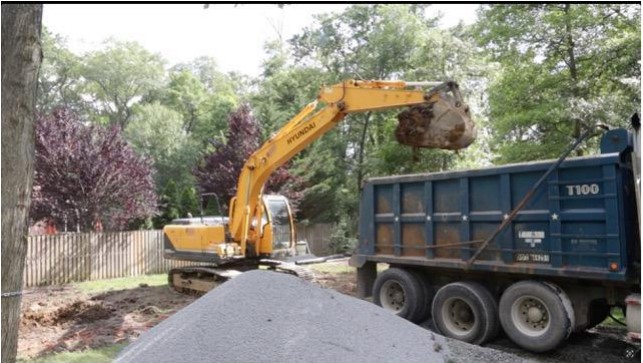
That threshold is the same 2,500 square feet we discuss on the Fairfax County page, but it lands differently here. On a cleared suburban lot, a pool project can often stay under it. On a wooded Great Falls lot, getting equipment and materials through mature trees to the build site — plus the shell, the decking, and a separate equipment pad — routinely pushes the disturbed area past 2,500 square feet even when the pool itself is modest. Cross that line and a Certified Arborist or Registered Consulting Arborist has to prepare a Tree Preservation Plan identifying a formal “Tree Preservation Target” before the county will sign off — a real cost and a real step that a comparable project on a cleared lot simply doesn’t hit.
Well and septic: the numbers that decide where the pool can go
A significant share of Great Falls properties run on private wells and septic systems rather than county water and sewer, administered through the Fairfax County Health Department’s Onsite Sewage and Water Program. Virginia’s own regulations set real, numeric separation distances that a pool location has to respect: a septic tank or pretreatment unit must sit at least 50 feet from a well, and a drainfield (including its reserve area) needs the same 50-foot clearance at minimum — more for higher-risk well classes. Building foundations need 15 feet of clearance from a well, and property lines need 5 feet (50 feet if the adjoining parcel is 3 or more agricultural acres, a real scenario on Great Falls’ more rural edges).
One rule matters specifically on Great Falls’ hillier terrain: if a well sits downslope of a septic system, the required separation increases by 25 feet for every 5% of slope. Neither state regulation names a pool specifically in its distance tables — Fairfax County reviews pool siting against your septic and well layout case by case — so treat any pool-to-septic number you hear as a starting point to confirm directly with the county, not a fixed rule. What is fixed is the order of operations: map your well, your septic system, and its reserve area before you pick a pool location, not after.
Floodplain near the Potomac — a separate rule from the RPA
If your property is anywhere near the Potomac River or Great Falls Park — Georgetown Pike, River Road, and Beach Mill Road corridor properties in particular — floodplain regulation is a different mechanism from the Resource Protection Area rules we cover on the Fairfax County page, and it can apply even to a lot that isn’t itself mapped as floodplain, if it abuts one that is. The zoning ordinance’s floodplain provisions require a Director determination for a proposed use in a floodplain, and anything that doesn’t meet the permitted-use criteria needs a special exception approved by the Board of Supervisors — a materially slower process than a standard residential pool permit. If river proximity is even a plausible question for your lot, check current FEMA mapping before you plan an excavation.
Conservation easements can eliminate part of your lot before zoning ever does
Recorded conservation easements are a real, if less common, feature of larger Great Falls parcels. The Northern Virginia Conservation Trust has completed a conservation easement on a 5-acre parcel in Great Falls near the Potomac — one property owner’s third such easement with the organization — permanently restricting new construction across the protected acreage. A recorded easement like this can flatly prohibit a pool in the covered area regardless of what your zoning setbacks would otherwise allow. Before finalizing a site plan on a larger or river-adjacent Great Falls lot, pull your plat and title work and check for a recorded easement — it’s a five-minute check that can save a redesign later.
HOA or no HOA — Great Falls runs both ways
Great Falls has a genuine mix of HOA-governed and unrestricted properties. Subdivisions like Lexington Estates First require architectural review board approval before any exterior change — explicitly including tree removal, driveway widening, and fencing, all directly pool-adjacent decisions — and Amberwoods of Great Falls requires the same before construction begins. Set against that are large, rural-flavor parcels with no HOA at all. Architectural review is a separate approval from your county permit and, in our experience, often the slower of the two, so if you’re in a governed subdivision, find out its submission calendar early and run both approvals in parallel. We cover the approval process in more depth in our guide to how HOAs affect your fiberglass pool project.
Wooded lots make automatic covers a genuinely different calculation
The R-E district’s own stated purpose is preserving “open and rural character,” and the county’s tree-preservation trigger above confirms, from the same primary sources, that Great Falls lots are officially recognized as more heavily wooded than the county norm. That has a practical consequence for pool ownership that has nothing to do with permitting: more overhead canopy means more leaf and debris load in the water, more strain on filtration equipment, and more manual skimming than a pool on a cleared lot ever needs. An automatic pool cover is a genuinely more valuable piece of equipment on a wooded Great Falls property than on an open suburban one — it’s a maintenance and water-quality decision worth making at the design stage, not an add-on to consider later.
Getting the shell onto a large, wooded lot
Large lots usually make delivery easier than a tight suburban street — more room for the truck, no need to close down a road, more flexible staging. On a wooded Great Falls property, though, the access route itself is constrained by the same tree-preservation rules above: you can’t simply clear a path through protected trees to shorten the route, and a long, tree-lined driveway sometimes needs grading or reinforcement work to support the weight of a delivery truck and crane. Walk the actual access route — driveway to pool site — before a shell model gets chosen, not after.
Fairfax County’s septic code gives swimming pools a 20-foot row
The county’s map of the Approved Sewer Service Area shows most of Great Falls outside it. The Wastewater Management office says a building must be inside that area to connect to public sewer, and the Board of Supervisors has historically not expanded it for new development or redevelopment. A septic system and well are likely to stay, and a pool has to fit around them.
The Health Department’s Onsite Sewage and Water Program administers Chapter 68.1 (septic systems) and Chapter 70.1 (wells) of the county code. The Chapter 68.1 separation table has a row for swimming pools: 20 feet from septic tanks, pretreatment units and the lines feeding the drainfield. The state’s published table has no pool row, and the county says its own text controls in a conflict. Ask which table applies to your lot.
Chapter 68.1 also bars any structure, such as a deck, patio or driveway, over the absorption area, and requires a reserve area equal to 100 percent of it on lots established after August 1, 2003. The county’s well table sets a drainfield 100 feet from a well; the state table allows 50 feet for some well classes. Locate the tank, absorption area, reserve area and well before a pool is drawn.
The county’s pool permit conditions change with soil class
Land Development Services publishes a soil table for minor building permits (projects under 2,500 square feet of land disturbance) with a swimming pool row. Class I soils need county inspections. Class II adds pressure release valves for when the pool is emptied, plus a base and walls on and backfilled with non-expansive material, or an engineered design. Classes III, IVA and IVB add an engineered design by a licensed Virginia engineer. The table does not separate pool types, so ask how it reads for a one-piece shell.
The county’s soil map puts most of Great Falls in Class I, mostly Glenelg silt loam, with a smaller share in Class IVB, mostly Wheaton-Glenelg complex. The county soil guide says excavations in Orange silt loam, very stony, may require blasting, with bedrock 4 to 6 feet down, and that blasting is often necessary in Rhodhiss-Rock Outcrop. Look up your parcel’s soil unit.
Part of Great Falls is mapped as potential asbestos soil
The Health Department’s asbestos page says naturally occurring asbestos has been mapped across about 11 square miles of Fairfax County, in greenstone bedrock. The Northern Virginia Soil and Water Conservation District says construction is not prohibited there, but major earth moving can reach the deep subsoil or bedrock. The county’s potential-asbestos soil layer covers a small part of Great Falls, mostly Orange silt loam. If your parcel is on it, call the Environmental Health Division (703-246-2444) before digging is scheduled.
A larger-lot front-yard rule and two historic districts
The county’s zoning layer puts most of Great Falls in R-E, with the rest largely R-1. On a lot larger than 36,000 square feet, the Zoning Ordinance lets accessory structures, a pool among them, sit in the front yard but not inside the minimum front setback: 50 feet in R-E, 40 feet in R-1 (Section 4102.7.A(6)(a)). Our McLean page covers the smaller-lot side.
The Colvin Run Mill and Dranesville Tavern historic overlay districts overlap Great Falls on the county map. Within them, a building permit for a structure needs Architectural Review Board approval first, and fences and structures must suit the landmark’s mass, scale, color and visual impact (Sections 3101.6.C, 3101.9 and 3101.10). Confirm your parcel with the county.
Draining an old Great Falls pool when there is no public sewer
Most of Great Falls is outside the county’s Approved Sewer Service Area, as described above, and that narrows the options when an old pool is emptied. Fairfax County’s pool water guidance says chlorinated or brominated water may be drained to a county storm drain or a stream only after the chlorine or bromine is removed. That means letting the pool sit 7 to 10 days or adding a chemical agent, then testing for less than 0.1 mg/L and a pH between 6.0 and 8.0. The county prefers that you drain over pervious, well-vegetated ground on your own property, avoid draining across neighboring properties, and treat a storm drain or stream as a last resort. For storm drains and streams it recommends 12 to 15 gallons per minute and sets a maximum of 25.
The guidance treats salt pools differently. Salt water should not go to a storm drain or stream, and the county says not to drain water from a salt pool into a septic system but to use a licensed sewage handling service. The public sanitary sewer options it lists, including small amounts of backwash through a household drain after calling Wastewater Management at 703-324-9389, assume a sewer connection that most Great Falls lots do not have. Plan the drain-down around the septic and well locations described above. Our guides to pool draining rules before removal and partial vs full pool removal cover the rest.
A sensible order of operations
- Confirm your zoning district and lot-size tier against the R-E and R-1 setback tables, and work out your accessory-structure setbacks.
- Check your plat and title for a recorded conservation easement or other restriction before you settle on a pool location.
- If you’re near the Potomac or Great Falls Park, check current FEMA floodplain mapping for your address.
- Map your well, septic system, and reserve area together with the pool site, respecting the state’s separation-distance tables.
- Read your HOA’s architectural guidelines, if you’re in a governed subdivision, and find out its submission calendar.
- Estimate your disturbed area — pool, decking, and the equipment route through the trees — against the 2,500 square foot Conservation Plan threshold.
- Then choose a shell model and access route that fit the envelope you’ve actually confirmed.
Doing it in that order costs nothing. Doing it in reverse is how wooded-lot projects stall.
What Calm Water Pools does in Great Falls
We have been a family-owned fiberglass pool company since 2008, working across Maryland, Washington D.C., Northern Virginia and nearby West Virginia. In Great Falls we offer full fiberglass pool installation, managing the project from shell selection through a finished pool and coordinating the build with licensed independent contractors; pool removal and replacement for aging concrete, vinyl-liner or damaged fiberglass pools; and fiberglass pool shells supplied on their own to homeowners, builders and contractors running their own installations. We also supply inground winter safety covers.
If you’re weighing whether a wooded or large-acreage Great Falls property is a good fit for a pool, that’s worth a conversation before you’ve picked anything out. Call 240-372-4440 or request a free quote.
Zoning districts, tree-preservation thresholds, floodplain maps and permit requirements change, and Fairfax County reviews well/septic siting for pools case by case. Everything above reflects our understanding of Fairfax County and Virginia requirements at the time of writing and is general guidance, not a substitute for confirming the current rules for your specific property with Fairfax County Land Development Services.
Related Reading
- Fiberglass pool installation in Fairfax County, VA
- How HOAs affect your fiberglass pool project
- Fiberglass pool FAQ — permits, timeline, installation quality and care
- Choosing a fiberglass pool: the complete guide
- Fiberglass pool installation in McLean, VA
- Fiberglass pool installation in Loudoun County, VA