
Fiberglass Pool Installation in Fairfax County, VA
Fairfax County is the largest single market in Northern Virginia for inground pools, and it is also one of the more involved places in the region to build one. Not because the county is unreasonable, but because three things converge here that most homeowners have never had to think about: an unusually broad stream-buffer ordinance, soils that behave badly east of I-95, and an HOA layer that runs on its own schedule. This page explains what actually shapes a fiberglass pool project in Fairfax County, so you can find out early whether your backyard works — before you have picked a model or spent anything.
Who issues the permit
Residential pool permits in Fairfax County go through Land Development Services, not the Health Department. That trips people up, because the Health Department does regulate pools — just public and community pools, like the ones at a neighborhood swim club. For a pool in your own backyard, Land Development Services is the office you are dealing with.
Expect a building permit for the pool itself, a separate electrical permit covering lighting, outlets, bonding and circulation equipment, and a plumbing or mechanical permit if you are adding a fuel-fired heater. The Virginia Uniform Statewide Building Code sets the trigger at water deeper than 24 inches, which every inground fiberglass pool clears. You will generally submit your house location plat along with pool plans.
The 2,500 square foot line that sets your timeline
This is the single most useful thing to know about permitting here. Fairfax County treats projects differently depending on how much ground you disturb — not how big the pool is.
Stay under roughly 2,500 square feet of land disturbance and the review can often be handled quickly and over the counter. Cross it, and the project triggers a grading or conservation plan, which is a different animal: engineered drawings, a refundable bond posted with the county, and a review that commonly adds anywhere from a few weeks to a few months before a building permit can even be issued.
Disturbed area is not just the hole. It includes your equipment path, spoil storage, staging, and the deck and hardscape around the pool. A modest pool with a large wraparound patio and a long access route can cross the line while a bigger pool with tight staging does not. If your schedule matters, this is worth designing around deliberately rather than discovering after the fact.
Resource Protection Areas — the Fairfax-specific one
Fairfax County adopted its Chesapeake Bay Preservation Ordinance (Chapter 118 of the county code) in 1993, with RPA boundaries expanded in 2003 after field studies of perennial streams. It designates Resource Protection Areas: tidal and nontidal wetlands, perennial streams, and generally everything within 100 feet of them.
Inside an RPA, development, land disturbance and vegetation removal are not permitted without prior county approval. Accessory structures — and a swimming pool is one — generally cannot be built inside that 100-foot buffer at all unless you obtain an exception. That process involves a Water Quality Impact Assessment and a public hearing before the county’s Exception Review Committee. It is not a rubber stamp, and if there is enough buildable area on your lot outside the buffer, the county’s position is that you should build there instead.
Fairfax County has a lot of stream corridors — the Difficult Run, Accotink Creek and Pohick Creek watersheds run through large parts of it — so RPAs affect far more residential lots than people expect, including plenty of ordinary subdivision backyards that simply back onto a drainage swale that turns out to be a mapped perennial stream.
Check this first. The county publishes a Watershed and Resource Protection Area Viewer and the JADE mapping application, both searchable by address. Both show approximate boundaries only — the county can require a site-specific delineation to fix the exact line. If a viewer shows an RPA anywhere near your intended pool location, get that resolved before anything else. See the county’s Chesapeake Bay Preservation Ordinance page and its RPA FAQs.
Marine clay, and why backfill material matters here
Fairfax County publishes a homeowner’s guide to marine clay for a reason. Marine clay — the Marumsco soils — occurs across widespread areas east of I-95, and it swells when it takes on water and shrinks when it dries. The county’s own literature associates it with land slippage and slope instability, poor foundation support, and poor drainage. It is the reason parts of eastern Fairfax County have a long local history of cracked foundations and moving retaining walls.
For a fiberglass pool this matters in three concrete ways. Excavation sidewalls in marine clay are less stable, which changes how the hole is cut and how long it can safely stay open. Drainage has to be designed to move water away from the shell rather than let it collect against it. And most importantly, marine clay is the wrong material to backfill a fiberglass shell with — it holds water and exerts pressure as it swells, which is exactly the load a one-piece shell should never see unevenly. Clean, free-draining backfill placed in lifts is not an upgrade here; it is the baseline.
Soils vary considerably across the county, so this is a site-specific question rather than a blanket one. It is worth knowing which side of the line your lot sits on before you finalize a location.
Barrier and fencing requirements
Virginia’s building code adopts the International Swimming Pool and Spa Code, and the barrier rules are consistent statewide:
- The barrier must be at least 48 inches high, measured from the ground on the side facing away from the pool.
- No opening may allow a 4-inch sphere to pass through.
- Gates must be self-closing and self-latching, and must open outward, away from the pool.
The fence itself normally needs its own permit, and your HOA very likely has an opinion about its style, height and material that is separate from — and sometimes stricter than — the code minimum.
HOAs run on their own clock
A large share of Fairfax County housing sits under an HOA or community association; Reston Association and Burke Centre Conservancy are among the largest, and hundreds of smaller subdivision associations operate across the county. Architectural review is a completely separate approval from your county permit, and in our experience it is often the slower of the two.
Associations commonly control fence style and height, equipment screening and placement, decking material and color, setbacks from shared property lines, permitted construction hours, and where trucks and equipment may stage. Some require their approval before you apply to the county. An HOA cannot override the building code, but it can comfortably add a month or more to a project that is otherwise ready. Submit to both in parallel. We go through the approval process in depth in our guide to how HOAs affect your fiberglass pool project.
Getting the shell into the backyard
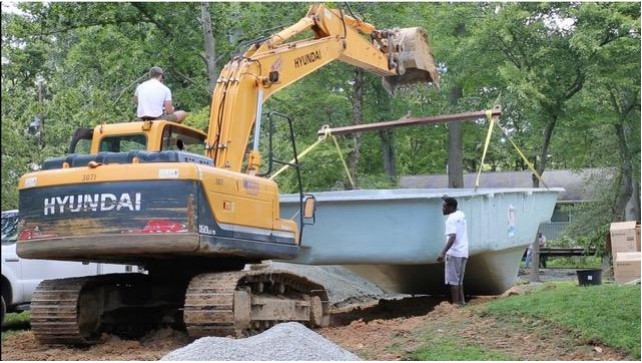
Fairfax County’s established neighborhoods bring the constraints you would expect from mature suburbs: heavy tree cover, fully fenced rear yards, sloped lots, and narrow side-yard access between houses. A one-piece fiberglass shell is typically 12 to 16 feet wide and completely rigid. It either fits the route to your backyard or it has to be craned over the house — which is a solvable problem, but one with cost and overhead-clearance implications you want identified on day one rather than delivery day.
Utility easements, septic fields, retaining walls and specimen trees all narrow the options further. This is the first thing we look at, because it constrains everything downstream.
Taking out an old pool in Fairfax County: the permit trail
If an old pool has to come out before a new shell goes in, Fairfax County’s Land Development Services treats it as a demolition. Its residential demolition page has two pool-specific lines. Utility disconnect letters are not required for pool demolitions. And for an accessory structure such as a pool, the county accepts an aerial image or conceptual exhibit in place of a house location plat when total land disturbance is under 2,500 square feet and the limits of disturbance are not within 15 feet of a floodplain boundary. That is the same 2,500-square-foot figure that sets the grading rules for a new pool, described earlier on this page.
The page also says a plumbing permit is needed for sewer cap-off if the property is on public sewer, and that the permits a project requires must pass final inspection before the demolition permit is issued. It does not say whether a pool-only removal triggers the cap-off, so ask the county before you assume either way. The county must be notified when the work reaches a stage that requires an inspection, and it strongly recommends that a properly licensed contractor pull the permits as the responsible party, although owners may pull them in their own name.
What comes out and what stays is a separate decision. See partial vs full pool removal and, for whoever does the work, how to verify a pool removal contractor.
A sensible order of operations
- Check for an RPA on your address using the county’s mapping tools. This has the power to eliminate a location outright.
- Pull your house location plat. You will need it for the permit, and it shows your setbacks and easements.
- Read your HOA’s architectural guidelines and find out what its submission calendar looks like.
- Walk the access route with a tape measure, gate to pool location.
- Estimate your disturbed area including deck and staging, and see whether you are near the 2,500 square foot threshold.
- Then choose a shell model that fits the envelope you have actually confirmed.
Doing it in that order costs nothing. Doing it in the reverse order is how projects stall.
What Calm Water Pools does in Fairfax County
We have been a family-owned fiberglass pool company since 2008, working across Maryland, Washington DC, Northern Virginia and nearby West Virginia. In Fairfax County we offer full fiberglass pool installation, managing the project from shell selection through a finished pool and coordinating the build with licensed independent contractors; pool removal and replacement for aging concrete, vinyl-liner or damaged fiberglass pools; and fiberglass pool shells supplied on their own to homeowners, builders and contractors running their own installations. We also supply inground winter safety covers.
If you are at the stage of wondering whether your Fairfax County backyard can take a pool at all, that is a conversation worth having before you have picked anything out. Call 240-372-4440 or request a free quote.
Permit requirements, ordinances and review thresholds change. Everything above reflects our understanding of Fairfax County requirements at the time of writing and is general guidance, not a substitute for confirming the current rules with Fairfax County Land Development Services for your specific property.
Related Reading
- Fiberglass pool installation in Great Falls, VA
- Fiberglass pool installation in Clifton, VA
- Fiberglass pool installation in McLean, VA
- Fiberglass pool FAQ — permits, timeline, installation quality and care
- Choosing a fiberglass pool: the complete guide
- Fiberglass pool installation in Arlington County, VA
- Fiberglass pool installation in Loudoun County, VA
- Fiberglass pool installation in Prince William County, VA