
Fiberglass Pool Installation in Arlington County, VA
Arlington is the smallest county in Virginia and one of the most densely built places in the country, and that single fact drives almost everything about putting a pool in an Arlington backyard. The county is not hostile to residential pools. But two constraints that barely register elsewhere in Northern Virginia — how much of your lot you are already allowed to cover, and how you physically get a rigid 16-foot object into a yard with no side yard — decide most Arlington projects before anyone talks about shell models. This page explains what those constraints actually are, so you can test your own lot against them early.
Who issues the permit
Residential pool permits run through Arlington’s Department of Community Planning, Housing and Development, submitted through the county’s Permit Arlington online portal. Expect a building permit for the pool, a separate electrical permit for bonding, lighting and circulation equipment, a fence permit for the barrier, and a gas permit if a fuel-fired heater is involved. A final building and barrier inspection has to be completed and passed before the pool is used.
Depending on your lot, you may also need a Land Disturbing Activity / Stormwater permit from the Department of Environmental Services, and a public right-of-way permit if equipment or a crane will occupy the street. Those are separate tracks with separate reviewers, and they are where Arlington timelines are actually made or lost.
Lot coverage: the number that decides whether you can have a pool at all
This is the Arlington-specific issue, and it is worth working out on paper before anything else.
Arlington caps how much of a one-family lot may be covered, as a percentage of the gross lot area, and the cap varies by zoning district. In the county’s zoning ordinance the maximum lot coverage for a one-family dwelling lot runs roughly from 45% in R-5, to 40% in R-6, 35% in R-8, 32% in R-10 and 25% in R-20, with modest increases allowed for a qualifying front porch or a detached rear-yard garage.
What makes this bite is what counts. Arlington’s definition includes:
- the main building footprint;
- accessory buildings over 150 square feet or two or more stories;
- driveways and parking pads — including unpaved center strips and any area regularly used for parking or maneuvering, paved or not;
- patios eight inches or more above finished grade;
- free-standing decks four feet or more above grade;
- gazebos and pergolas, with or without foundations;
- and in-ground swimming pools.
Notably, the ordinance excludes above-ground pools, hot tubs, sidewalks and walkways, equipment such as compressors and generators, and play equipment and outdoor furniture. An in-ground pool is the version that counts against you.
Run the arithmetic on a realistic lot. A 6,000 square foot R-6 lot has roughly 2,400 square feet of coverage to spend. A house footprint in the region of 1,800 square feet plus a driveway and parking pad can consume nearly all of it, before you have drawn a pool. On a lot that has already been through a teardown-and-rebuild — which describes a great deal of Arlington’s housing stock over the past two decades — the coverage budget is often close to exhausted by design.
There are usually moves available: keeping surrounding patio below the eight-inch threshold so it does not count, choosing a smaller shell, reworking the driveway, or shifting hardscape to walkways. But they are design decisions that need to happen at the beginning. Confirm your zoning district and pull your existing coverage figure before you fall in love with a layout.
Two land-disturbance thresholds, not one
Arlington is a Chesapeake Bay Act locality, which puts its erosion and stormwater threshold at 2,500 square feet of land disturbance — considerably tighter than the 5,000 square feet used in Loudoun County. At or above 2,500 square feet you need a Land Disturbing Activity / Stormwater permit.
Since July 1, 2025 there is also a middle tier that is easy to miss. If your total disturbed area falls between 2,000 and 2,499 square feet, you do not need the full permit, but you do have to certify the disturbed area, obtain a survey with markings on site, and install silt fence or another approved perimeter control before the permit is issued. Under 2,000 square feet, neither applies.
And there is a rule that catches homeowners doing work in stages: if the land disturbance from multiple separate projects within a two-year period adds up to the 2,500 square foot threshold, the permit is required anyway. A patio last summer, a driveway this spring and a pool this fall are not three independent projects in the county’s arithmetic.
Arlington has also tightened what single-family projects must do since 2021 — meeting state stormwater quantity standards as well as quality, soil de-compaction and amendment, making sure runoff is not concentrated toward downhill neighbors, and accounting for existing forested area. A streamlined compliance path exists for moderate-scale single-family projects that add under 750 square feet of new impervious rooftop and pavement, which is often the target worth designing toward.
Resource Protection Areas along Arlington’s streams
Arlington’s Resource Protection Areas cover its streams, wetlands and tidal shores plus the environmentally sensitive land within 100 feet of them. On a county this compact, with stream corridors running through Four Mile Run, Donaldson Run, Gulf Branch, Windy Run, Lubber Run and Spout Run, that touches far more residential lots than most homeowners expect — including ordinary backyards that simply slope down to a wooded strip.
One Arlington detail worth knowing: steep slopes of 25% or greater adjacent to a buffer are part of the RPA too, because of erosion potential. A lot that appears to be a comfortable distance from the water can still be inside the protected area on the strength of its grade.
Inside an RPA, existing trees and vegetation are protected and building work is restricted. Getting permission for regulated activity involves a Water Quality Impact Assessment. Arlington’s Chesapeake Bay Preservation Ordinance was updated effective September 1, 2025, with stronger tree-conservation and buffer-replanting expectations following changes at the state level, so guidance written before that date may no longer be accurate. The county publishes an RPA and floodplain lookup by address — check it at the start. See Arlington’s Resource Protection Area page.
How the zoning ordinance treats the pool barrier and lighting
Virginia’s building code sets a statewide minimum barrier height of 48 inches. Earlier editions of Arlington’s zoning ordinance set a higher bar for private pools, requiring the fencing around a private swimming pool to be no less than six feet. The edition effective June 13, 2026 no longer carries that requirement in its private-pool section (Section 12.9.17), and the six-foot minimum now appears only for community, semi-public and commercial pools (Section 12.4.8). The private-pool section keeps a lighting rule: any pool lighting must be arranged and hooded so that direct light stays within your own property lines — a rule that only makes sense in a place where the neighboring house is twenty feet away, and a good illustration of how Arlington thinks about backyards.
The ordinance still caps how tall a fence may be in required yards: up to 4 feet in a required street setback and up to 7 feet in a required rear or side yard, with exceptions for corner lots (Section 3.2.6.A.3(e)). Because Arlington amends its zoning often, confirm with the county whether any pool-barrier requirement applies beyond the building code before ordering fencing. The county’s zoning ordinance page carries the current text.
Getting a shell into an Arlington backyard
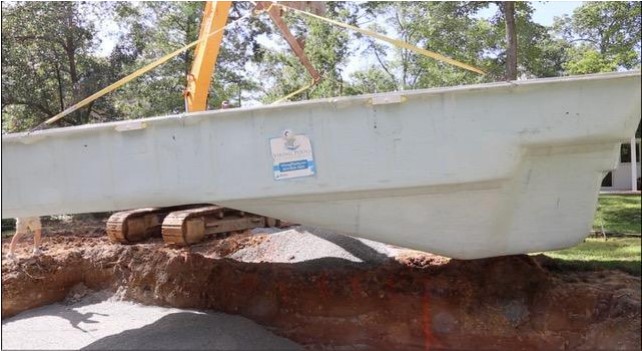
In most of Northern Virginia, the shell reaches the backyard down a side yard. In much of Arlington there is no side yard wide enough — houses on 5,000 to 8,000 square foot lots, often with fences, air conditioning units, window wells and utility meters occupying the gap. So the realistic route is usually one of three:
- An alley, where the neighborhood has one. Several older Arlington neighborhoods do, and it is the easiest answer when the turning geometry works.
- A crane over the house. Entirely routine, but it needs a staging position for the crane, clear overhead space, and coordination around Arlington’s dense overhead utilities and mature street trees. If the crane sits in the street, that means a right-of-way permit and a traffic plan — not difficult, but not same-day either.
- A rear route from an adjoining property, which depends on a neighbor’s goodwill and their lawn.
The tree canopy cuts both ways here. It is one of the best things about Arlington backyards and one of the most common reasons a crane pick has to be rethought. Get the access route assessed before design, not after — it is the constraint that most often changes the answer.
No HOA — but check for a historic district
Most single-family Arlington neighborhoods have civic associations rather than homeowners associations. A civic association is a voluntary neighborhood organization; it has no architectural approval authority over your backyard. If you have moved here from Loudoun or Fairfax, that is a genuine simplification — one whole approval track disappears.
Two exceptions matter. Townhouse and condominium communities do have real associations with real covenants. And Arlington has local historic districts — Maywood is the best known — where exterior alterations, new construction and demolition require a Certificate of Appropriateness reviewed under the Historical Affairs and Landmark Review Board. Many routine items are now handled administratively by staff rather than at a board hearing, but a fence in a local historic district is a reviewable exterior alteration, and the review is a real step in the schedule. Find out whether your address is inside a district before you plan the fence.
Where the zoning ordinance puts a pool and its equipment
Arlington’s Zoning Ordinance keeps every structure except walls and fences out of a required yard (Section 3.2.6.A.3(a)), and defines a structure as anything constructed or erected that requires location on the ground. On a one-family lot the side yards are 10 feet, with one side allowed down to 8, and on interior lots nothing may sit closer than 25 feet to the rear lot line (Section 3.2.6.A.2(b)). One-family structures generally must stay 25 feet from any street right-of-way line, which on a corner lot includes the street side (Section 3.2.6.A.1(e)).
The one pool item the ordinance names is equipment. Pumps, heaters and similar gear may sit in a required side or rear yard, but no closer than 8 feet to a side lot line or 10 feet to a rear lot line (Section 3.2.6.A.3(b)). Those paragraphs do not single out the shell, so ask the zoning reviewer in writing how your pool is measured before the layout is fixed.
A new pool in a Resource Protection Area goes to a committee
The county’s Resource Protection Area page lists “new swimming pools” among the projects that need an exception from the Chesapeake Bay Ordinance Review Committee. These requests go to the committee, not to staff alone.
CBORC has five citizen members, meets as needed (typically two or three times a year) and must hold a public hearing. The plan and staff report are open to the public for 10 business days first, and the county notifies adjacent owners and the civic association. The county says this typically adds about 8 weeks. It can grant the request, add conditions, or refuse it. Check the county’s RPA map for your parcel before choosing a location.
Arlington’s soil map is mostly urban land, with wet spots
The USDA Natural Resources Conservation Service (NRCS) soil survey of Arlington County (area VA013) covers 16,700 acres. Its largest map unit, at 5,055 acres, is an Urban land-Udorthents complex. NRCS classes urban land as a miscellaneous area, not a soil, so the map says little about one backyard. It lists no marine clay, the soil behind the problems on our Fairfax County page, and rates its named soils low for shrink-swell.
Wetness is the local issue. NRCS describes Neabsco soil on Coastal Plain terraces as moderately well drained, with a fragipan 15 to 39 inches down and a seasonal water table at about 21 inches from November through April. The official series description says perched water commonly sits above that layer in winter and spring.
As practice, not code, water against a shell is a pressure question. Latham’s installation timeline describes a sump line or daylight drain at the deep end to balance hydrostatic pressure. A site investigation answers what the map cannot.
Draining an old pool: sewer first, storm drain only if treated
Arlington says it is illegal to discharge pool water containing chlorine, debris, saltwater, biocides or other chemicals to the storm drain system or streams (County Code Section 26-7.C). It asks homeowners to drain slowly to the sanitary sewer when possible, through a private lateral cleanout.
Otherwise, its pool drainage guidance asks for water with no detectable chlorine or bromine (untreated water sits about 10 days), neutral pH and no debris, released slowly over grass at least 10 feet from the property line. Backwash water cannot go to the storm drain, and saltwater may not go to a storm drain or stream. Residents can be held responsible for their pool service company’s actions, so ask how a drain-down will be handled.
Taking out an old pool in Arlington: what the demolition permit asks for
Arlington takes demolition applications through Permit Arlington, and its demolition permit page does not mention pools, so ask the county whether removing a pool needs a demolition permit, a pool permit or both. If the demolition permit applies, the page lists these steps: written notice to each potentially affected adjoining owner at least one week before demolition begins; a disconnect letter from the electric and gas providers, or an owner’s certification that the structure is not served; and a closure letter from Utility Services if it has water or sewer service. Disturbing 2,500 square feet or more also needs a separate land disturbing activity and stormwater permit, approved before the demolition permit is issued. That is the same 2,500-square-foot line described above for a new pool. Residential reviews take up to two business days.
The page also says a Permit Authorization Affidavit is generally required unless the permit holder is a Virginia-licensed contractor for the work or is both the property owner and the applicant. The draining rules for the old pool’s water are covered above. Our guides to partial vs full pool removal and how to verify a pool removal contractor help with the rest of the planning.
A sensible order of operations
- Find your zoning district and calculate your existing lot coverage. This is the one that most often decides feasibility outright.
- Check the county’s RPA and floodplain lookup for your address, including whether steep slopes pull you in.
- Estimate total disturbed area — including the deck, staging and access route — and see which side of 2,000 and 2,500 square feet you land on. Include anything else you have disturbed in the past two years.
- Settle the access route: alley, crane, or neighboring property. If it is a crane from the street, plan for a right-of-way permit.
- Check for a local historic district and for townhouse or condo covenants.
- Then size the shell to the coverage and access envelope you have actually confirmed.
None of that costs anything. Working in the reverse order is how an Arlington project discovers in June that the design it commissioned in March exceeds lot coverage by 200 square feet.
What Calm Water Pools does in Arlington County
We have been a family-owned fiberglass pool company since 2008, working across Maryland, Washington DC, Northern Virginia and nearby West Virginia. In Arlington County we offer full fiberglass pool installation, managing the project from shell selection through a finished pool and coordinating the build with licensed independent contractors; pool removal and replacement for aging concrete, vinyl-liner or damaged fiberglass pools; and fiberglass pool shells supplied on their own to homeowners, builders and contractors running their own installations. We also supply inground winter safety covers.
Because a fiberglass shell arrives in one piece and in one size, Arlington is a place where the honest answer is sometimes that a particular lot will not take a particular pool. That is a much better thing to establish in a conversation than at a delivery. Call 240-372-4440 or request a free quote.
Ordinances, coverage limits and permit thresholds change, and Arlington has revised several of these rules recently. Everything above reflects our understanding of Arlington County requirements at the time of writing and is general guidance, not a substitute for confirming the current rules for your specific property with Arlington County.